30 YEARS OF WCRCI IN GERMANY 🇩🇪
BISHOP EVANS NGOZI IZUWA
Thirty Years of Ministry, Mission and Kingdom Advocacy
Year 1996 – 2026
From an Asylum-Camp Fellowship in Germany to a Ministry of Reconciliation, Kingdom Governance and Global Christian Advocacy
PROLOGUE
A Journey That Began in Obscurity
Some lives are best understood not by beginning with titles, institutions or achievements, but by returning to the place where the journey began.
The public ministry of Bishop Evans Ngozi Izuwa did not begin with the title “Bishop.” It did not begin with a cathedral, an international organisation, a published book or a governance movement.
Its documented German history reaches back to 1996 and to the experience of an African Christian minister living within the immigrant environment of Germany.
According to the institutional history of World Christian Revival Center International e.V. (WCRCI), what eventually became an established Christian ministry in Oberhausen began as a small house fellowship in an asylum centre in Duisburg in 1996. The organisation states that the fellowship subsequently developed into a formally registered Christian ministry in 1998.
What makes this account particularly significant is that the early ministry is not known exclusively from Izuwa’s later recollections.
An independent German theological source provides an unusually valuable historical window into those formative years.
In a conversation conducted in March 2000 and subsequently published in the “Handbuch Interkulturelle Seelsorge”, a Nigerian-born pastor identified as “Evans Nwiku” is described as having served since “1996 as pastor of Victory Christians Ministries in Oberhausen”. The congregation was described at that time as an international, English-speaking Christian community of approximately 140 members. ([SIPCC][2])
Later ministry sources identify Victory Christian Ministries as the predecessor of World Christian Revival Center International and associate the published intercultural conversation with Evans Ngozi Izuwa. ([End of the Matter][3])
The difference between the historical name “Evans Nwiku” and the later-established “Evans Ngozi Izuwa” deserves documentary clarification in any future archival edition. Yet the convergence of location, nationality, ministry, chronology and institutional history provides substantial contextual evidence connecting the historical record with the ministry that followed.
From those beginnings emerged a ministry that, over the following thirty years, would move through several distinct but interconnected stages:
“pastoral ministry, African-diaspora ministry, prison and detention outreach, integration work, intercultural mediation, reconciliation, Christian publishing, leadership development and Kingdom-governance advocacy.”
The story of Evans Ngozi Izuwa between 1996 and 2026 is therefore not merely the history of a preacher.
It is the history of an evolving Christian vocation.
PART ONE
ROOTS, CALLING AND FORMATION
Chapter One
From Mbaise to the Nations
Evans Ngozi Izuwa traces his family roots to “Okwuta Amumara, Ezinihitte Mbaise Local Government Area of Imo State, Nigeria”.
His official biography identifies his parents as “Mr. Daniel Izuwa Nwogu and Rev. Mrs. Mercy Izuwa Nwogu”. ([End of the Matter][3])
The spiritual interpretation of his life begins even before his birth.
According to Izuwa’s testimony, his mother survived a serious illness before his conception and subsequently dedicated the child she would bear to God. He understands this maternal act through the biblical pattern of Hannah’s dedication of Samuel.
Such an experience belongs properly to the category of “personal and family testimony”. Historical research cannot independently establish its spiritual meaning. Nevertheless, it is important biographically because it helps explain how Izuwa himself understands his vocation.
His ministry identity was therefore not constructed retrospectively merely around professional success.
In his own understanding, ministry was a calling before it became an occupation.
The official biography describes him as having entered Christian service while young and as having subsequently received training and influence from different Christian leaders. ([End of the Matter][3])
Those Nigerian roots would remain important even after Germany became the principal theatre of his public ministry.
Chapter Two
Germany and the Wilderness Years
The German chapter of Izuwa’s life cannot be separated from the realities of African migration in Europe during the 1990s.
His organisation describes the beginnings as difficult: ministry emerged among immigrants and asylum seekers rather than from a position of institutional privilege. ([End of the Matter][4])
This background is important.
Later emphases in Izuwa’s ministry, human dignity, immigration, reconciliation, prison visitation, integration, law, justice and responsible citizenship, can be understood more clearly when placed beside these formative experiences.
The strongest independent source from this period is the intercultural conversation published with Rev. Dr. Claudia Währisch-Oblau.
The discussion does not present a polished retrospective success story. Instead, it places the African pastor directly within difficult pastoral realities surrounding Nigerian migrants, asylum procedures, deportation detention, cultural differences and differing African and German approaches to pastoral care.
The source states plainly that the Nigerian-born Evans Nwiku had served as pastor of Victory Christians Ministries in Oberhausen since 1996. ([SIPCC][2])
This establishes something of lasting historical importance:
“by March 2000, the ministry was already sufficiently established to enter a documented intercultural theological conversation within the German Protestant environment.”
PART TWO
BUILDING A CHURCH IN A FOREIGN LAND
Chapter Three
Victory Christian Ministries
The first known institutional expression of the ministry was “Victory Christian Ministries”.
According to the later WCRCI account, what began with only a few people grew until the ministry became formally registered in 1998. ([End of the Matter][1])
The independent 2000 record is especially valuable because it gives a contemporary picture rather than a later reconstruction.
At that point, the congregation was described as international and English-speaking, with approximately “140 members”. ([SIPCC][2])
That suggests that within approximately four years of the stated 1996 beginning, the ministry had moved substantially beyond the scale of its original fellowship.
Its constituency reflected one of the changing realities of European Christianity: Christianity in Germany was no longer represented exclusively by Germany’s historic churches.
African, Asian and other immigrant Christian communities were increasingly becoming visible participants in the country’s religious landscape.
Izuwa’s ministry developed within this historical transition.
Chapter Four
From Victory to World Christian Revival Center International
Victory Christian Ministries subsequently became known as “World Christian Revival Center International e.V.”
The organisation today gives its German registration number as “VR 41430” and identifies its principal base in Oberhausen. ([End of the Matter][1])
Independent ecclesiastical documentation confirms the congregation’s later institutional presence.
A directory of international congregations associated with the “Evangelical Church in the Rhineland (EKiR)” lists:
World Christian Revival Center
WCRCI-House
Ruhrorter Straße 9
46049 Oberhausen
Pastor Evans Izuwa.
The same record documents Sunday Bible study and worship, Wednesday prayer, Friday Bible study and Bible-study activities in Duisburg, Oberhausen and Krefeld. ([Ekir][5])
This record is significant because it establishes both the congregation and Evans Izuwa through an external German church source.
The ministry had moved from an immigrant fellowship into an identifiable part of North Rhine-Westphalia’s intercultural Christian landscape.
PART THREE
MINISTRY BEYOND THE PULPIT
Chapter Five
The African Diaspora and the Responsibility of Integration
A persistent theme in Izuwa’s ministry has been his concern for Africans living outside Africa.
His institutional biography describes a particular emphasis on encouraging African immigrants in Germany to become responsible residents, obey the laws of their host country and represent their Christian faith constructively despite the pressures associated with migration and integration. ([End of the Matter][4])
The same biography states that this concern contributed to his involvement as a founding member and, at one period, president of the “Council of African Churches NRW Germany”. ([End of the Matter][3])
The presidency claim currently rests primarily upon his institutional biography and would benefit from additional independent Council archives.
Nevertheless, the wider picture of community involvement is independently corroborated by municipal records.
And those records reveal that the ministry’s understanding of integration eventually became practical rather than merely rhetorical.
Chapter Six
The Prison Gates
WCRCI dates the establishment of Izuwa’s prison ministry to “2002”.
According to the organisation, the ministry extended into prisons and deportation-detention facilities and particularly addressed people experiencing the vulnerabilities associated with incarceration and immigration status. ([End of the Matter][3])
WCRCI’s current institutional description still identifies prison and deportation-detention pastoral care as a central component of its mission. ([End of the Matter][1])
Individual accounts of miraculous intervention or supernatural deliverance belong to the ministry’s testimony and should be preserved as testimony rather than presented as independently established historical events.
But the prison ministry itself fits an important pattern in Izuwa’s development.
The pastor who had experienced ministry among migrants increasingly found himself working at the intersection of:
“faith, law, human vulnerability, justice and restoration.”
Those themes would later become central to his mediation and Kingdom-governance teaching.
PART FOUR
FROM IMMIGRANT CHURCH TO CIVIC ENGAGEMENT
Chapter Seven
Oberhausen: Ministry Meets the City
One of the clearest independent confirmations of WCRCI’s social engagement comes not from a church source but from the “City of Oberhausen”.
In 2011 the city documented WCRCI as the responsible organisation for a micro-project titled:
“Vorbereitung auf den beruflichen Einstieg” – Preparation for Entering Professional Employment.
The project operated from “1 April until 31 December 2011”. ([Oberhausen][6])
Its primary beneficiaries were young African migrant women.
The project sought to strengthen German-language ability and computer literacy, introduce participants to German workplaces through excursions, provide information about Germany’s education and employment systems and help participants develop practical skills required for employment applications. ([Oberhausen][6])
The City of Oberhausen’s project overview explicitly states that the programme was intended to prepare African women for employment and contribute to their social integration. ([Oberhausen][7])
This constitutes unusually strong independent evidence for an important dimension of WCRCI’s work.
The church was not operating solely within the sanctuary.
It was participating in organised social-integration activity within the German municipal environment.
Chapter Eight
At the Civic Table
Another Oberhausen municipal record adds the individual pastor himself to the historical picture.
Documentation for the “Sozialraumgespräch Mitte/Styrum” held on “9 June 2011” lists “Evans Izuwa” among participants alongside representatives from schools, churches, social agencies, political groups, employment institutions and community organisations. ([Oberhausen][8])
This seemingly small archival entry is historically important.
It places Izuwa personally within the city’s community-development conversation.
The evidence therefore demonstrates a progression:
The immigrant pastor had become not merely the leader of an African congregation but a participant within a broader civic and intercultural network.
Chapter Nine
The 2010 Church Dedication and Public Recognition
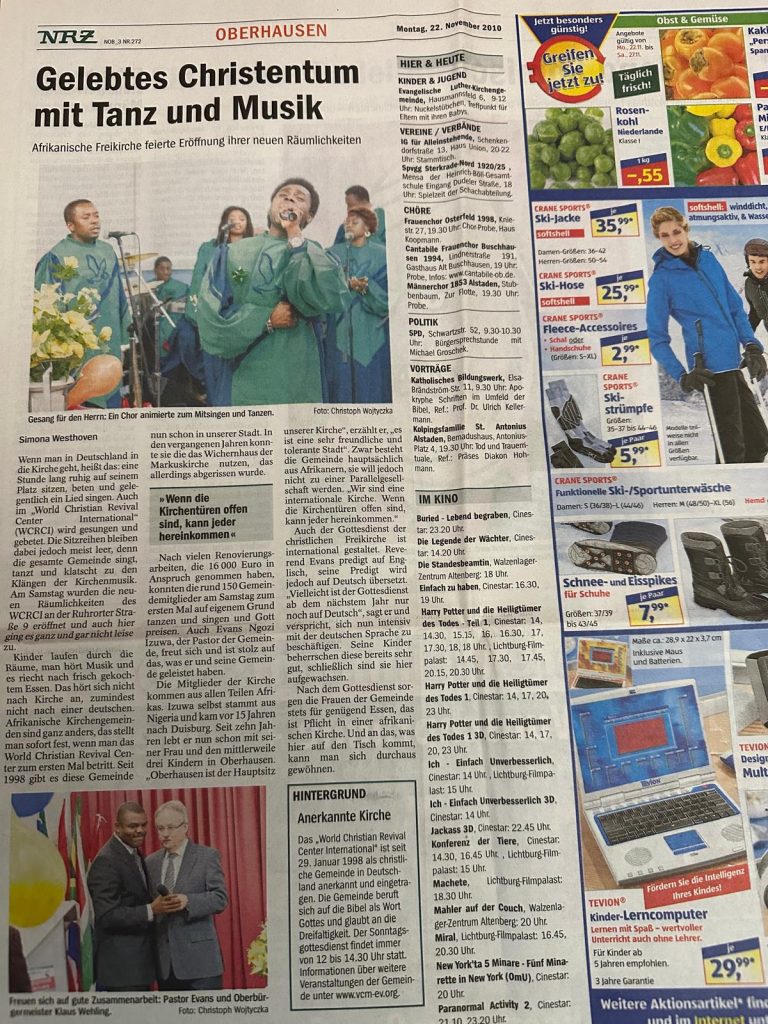
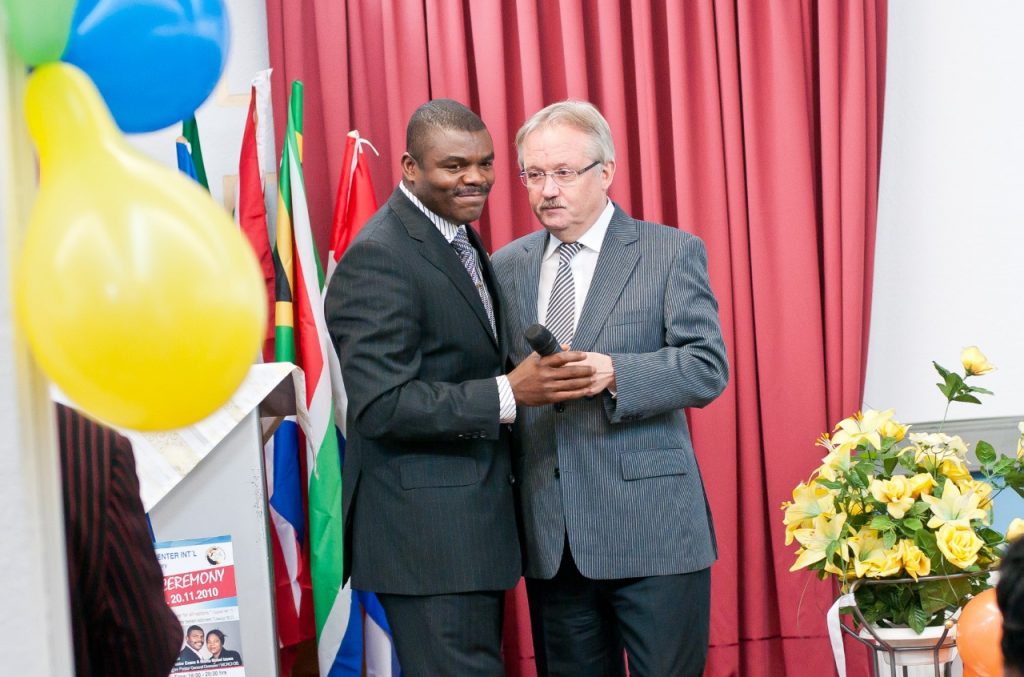
WCRCI identifies “20 November 2010” as an important date in its institutional history.
According to the church, the then Lord Mayor of Oberhausen, “Klaus Wehling”, attended the official dedication of the church centre as guest of honour. WCRCI also reports that Izuwa was subsequently received by the mayor at his office. ([End of the Matter][1])
The organisation preserves photographs associated with these events.
At present, however, this account is most clearly documented through WCRCI’s own historical archive. An independent municipal or newspaper record conclusively confirming the dedication has not yet been located in the research undertaken for this biography.
A historical biography should therefore retain the event while transparently identifying its documentary basis.
Such transparency strengthens rather than weakens historical credibility.
PART FIVE
RECONCILIATION AS A VOCATION
Chapter Ten
The Mediator
By 2011 another dimension had emerged.
Izuwa’s official biography states that in “May 2011” he completed specialised training in intercultural mediation through the “INeKO Institute associated with the University of Cologne”, reportedly with public sponsorship. ([End of the Matter][4])
According to his testimony, he subsequently understood himself to have received a divine commission to establish a:
“Reconciliation and Conflict Resolution / Mediation Center.”
The spiritual commissioning is a personal faith claim.
The professional mediation identity, however, continued publicly thereafter. His professional LinkedIn presence identifies him with a “Reconciliation and Conflict Resolution / Mediation Center” in Oberhausen. ([LinkedIn][9])
A German business directory likewise associates Pastor Izuwa Ministries with mediation and conflict-resolution work across interpersonal, family, organisational and community settings. ([Cylex][10])
The exact 2011 INeKO certificate itself has not been independently inspected during this research, so a definitive archival biography should ideally reproduce or reference the original certificate.
Nevertheless, reconciliation had clearly become an important part of Izuwa’s public professional and ministry identity.
Chapter Eleven
Justice, Peace and Human Dignity
Mediation introduced language that would later become central to Izuwa’s theological development:
“justice.
peace.
reconciliation.
responsibility.
human dignity.”
These ideas provided a bridge between pastoral ministry and his later concept of Kingdom governance.
The transformation was gradual.
He did not abandon evangelism in favour of social activism.
Rather, his developing argument was that Christian faith should produce consequences for relationships, institutions and the exercise of authority.
That conviction would eventually lead beyond reconciliation toward the question:
How should human beings govern when they recognise themselves as accountable to God?
PART SIX
THE KINGDOM GOVERNMENT ADVOCATE MANDATE
Chapter Twelve
4 February 2021
The next decisive date in Izuwa’s account is “Thursday, 4 February 2021”.
Izuwa testifies that on that date he received the mandate that became the “Kingdom Government Advocate Mandate (KGAM)”. ([Kgam Global][11])
KGAM describes its mission as raising and training advocates who understand biblical concepts of governance and who can carry principles of righteousness, justice and responsible authority into institutions including government, civil service, judiciary structures, traditional leadership and communities. ([Kgam Global][11])
This represented a significant enlargement of Izuwa’s ministry vocabulary.
The question was no longer only:
“How should Christians live?”
It increasingly became:
How should authority itself be understood and exercised under God?
Chapter Thirteen
From Church Government to Kingdom Governance
Izuwa’s Kingdom-governance teaching rests upon a fundamental distinction.
The “Kingdom of God”, in his framework, cannot be reduced to church administration.
It concerns God’s sovereignty and therefore has implications for human stewardship wherever authority operates.
This framework places particular emphasis on:
・ righteousness;
・ justice;
・ accountability;
・ stewardship;
・ responsible authority;
・ human dignity;
・ service;
・ ethical leadership;
・ restoration of legitimate order.
His contemporary author profile accordingly identifies his work with ethical governance, public leadership, law enforcement, education, community leadership, discipleship, cultural restoration and societal transformation. ([Kgam Global][12])
KGAM therefore represents the institutionalisation of concepts that had been emerging throughout earlier phases of his ministry.
PART SEVEN
THE AUTHOR AND THE MESSAGE
Chapter Fourteen
When Preaching Became Publishing
By the middle of the 2020s, Izuwa’s teaching increasingly moved from sermons and seminars into books and structured frameworks.
His writing addresses recurring questions:
What gives authority legitimacy?
What happens when societies abandon foundational order?
What is the relationship between righteousness and government?
How should Christians understand policing, security and public service?
What did Christ bring to completion?
What distinguishes religious activity from Kingdom relationship?
How should a person chosen by God exercise authority?
These questions connect his publications rather than leaving them as unrelated titles.
Chapter Fifteen
Kingdom Law Enforcement
One of the clearest expressions of the governance framework is:
Kingdom Law Enforcement: Transforming Police, Army, and Security Through Kingdom Culture.
The underlying proposition is that security institutions are not morally neutral instruments.
Those entrusted with coercive public authority carry an exceptional responsibility to exercise that authority justly.
The subject therefore connects biblical concepts of justice and righteousness with police, military and security service.
Within Izuwa’s wider intellectual development, “Kingdom Law Enforcement”represents the extension of Kingdom theology into one of society’s most consequential expressions of governmental power.
Chapter Sixteen
The End of the Matter
Another major stream of Izuwa’s later theology is intensely Christological.
His teaching increasingly places “Christ Himself” rather than religious systems at the centre of Christian faith.
This orientation is expressed in the work:
End of the Matter – Christ the End of Religion and the Beginning of Kingdom Relationship.
Its central concern is the distinction between religious striving and relationship with God through Christ.
This Christ-centred emphasis is essential for understanding Izuwa’s governance teaching correctly.
In his own theological system, “Kingdom governance does not begin with politics. It begins with Christ.”
Chapter Seventeen
The Ancient Landmark
In “August 2026”, WCRCI and KGAM announced the publication of:
“The Odds of Changing the Ancient Landmark: A Call to Restore Order in Families, Churches, and Nations.” ([Kgam Global][13])
The organisation states that the book emerged from approximately “eight years and eight months” of research, reflection, writing and revision. ([Kgam Global][13])
Drawing upon Proverbs 22:28, the work addresses boundaries, inheritance, identity, responsibility and foundational order across family, faith, culture, leadership, governance and society. ([Kgam Global][13])
Its concern is not that everything inherited must remain unchanged.
Rather, the underlying question is whether reform can distinguish between an unjust tradition that ought to be changed and a legitimate foundation whose destruction produces disorder.
This distinction between “reform and removal” occupies an important place within Izuwa’s later thought.
PART EIGHT
THE ARCHITECTURE OF A THIRTY-YEAR MESSAGE
Chapter Eighteen
One Journey, Several Expressions
Seen chronologically, Izuwa’s ministry can appear to contain many separate activities:
church planting;
immigrant ministry;
prison visitation;
integration programmes;
mediation;
reconciliation;
leadership development;
publishing;
Kingdom governance.
But viewed retrospectively, an underlying continuity becomes visible.
The asylum experience raised questions about “human dignity”.
Immigrant ministry raised questions about “identity and responsible citizenship”.
Prison ministry confronted “law, justice, mercy and restoration”.
Integration projects addressed “participation and empowerment”.
Mediation dealt with “conflict, justice and reconciliation”.
Kingdom governance addressed “authority, righteousness and institutional responsibility”.
His books increasingly attempted to organise these experiences into a coherent theological framework.
Thus what appears externally as expansion can also be understood internally as consolidation.
Chapter Nineteen
Christ at the Centre
The theological architecture can be represented in a simple progression:
“CHRIST”
↓
THE KINGDOM OF GOD
↓
THE WILL AND GOVERNMENT OF GOD
↓
RIGHTEOUSNESS AND JUSTICE
↓
LEGITIMATE AUTHORITY
↓
RESPONSIBLE AMBASSADORS AND ADVOCATES
↓
FAMILY – CHURCH – COMMUNITY – INSTITUTIONS – NATIONS
This provides a conceptual key for interpreting Izuwa’s later writings.
The intended endpoint is not merely religious expansion.
It is the formation of people whose character and exercise of authority reflect the principles they profess.
PART NINE
THE MAN BEHIND THE PUBLIC MINISTRY
Chapter Twenty
Family, Spiritual Formation and Fatherhood
Izuwa’s institutional biography identifies him as the father of three children: “Topmann, Wisdom and Knowledge”. ([End of the Matter][3])
His spiritual formation has also been shaped by relationships with Christian leaders. His biography particularly identifies “Bishop David O. Oyedepo” as his spiritual father while describing the Holy Spirit as his ultimate teacher. ([End of the Matter][3])
These relationships belong to the internal spiritual history of his ministry.
They help explain the strong vocabulary of faith, divine calling, covenant, authority and biblical mandate that characterises his preaching and writing.
Yet his public record also demonstrates that his ministry has repeatedly operated outside purely ecclesiastical settings, in municipal projects, intercultural dialogue, migration issues and mediation.
The two dimensions have therefore existed alongside each other:
“a charismatic Christian spirituality and an increasing concern for public responsibility.”
PART TEN
THIRTY YEARS LATER
Chapter Twenty-One
1996 – 2026: From Fellowship to Framework
Thirty years provide sufficient distance to identify the broad phases of a life in ministry.
1996 – 2000 – Foundation
An African immigrant ministry takes shape in Germany.
A small fellowship develops into Victory Christian Ministries.
By March 2000, an independent theological record identifies its Nigerian-born pastor and describes an international congregation of approximately 140 people. ([SIPCC][2])
2001 – 2010 – Consolidation
The ministry develops beyond its earliest immigrant-fellowship identity.
Prison and detention outreach become part of its mission.
Victory Christian Ministries develops into World Christian Revival Center International.
2010 – 2011 – Public Engagement
The church reports the dedication of its Oberhausen centre in November 2010. ([End of the Matter][1])
Official municipal documentation in 2011 establishes WCRCI’s participation in employment and integration programmes for African migrant women. ([Oberhausen][6])
Evans Izuwa appears personally in Oberhausen community-development documentation. ([Oberhausen][8])
2011 – 2020 – Reconciliation
Intercultural mediation and conflict resolution become increasingly prominent.
The pastoral vocation expands into reconciliation and mediation.
2021 – 2025 – Kingdom Governance
Izuwa dates the Kingdom Government Advocate Mandate to 4 February 2021. ([Kgam Global][11])
Governance, righteousness, justice, leadership and institutional transformation increasingly define his teaching.
2025 – 2026 – The Authorial Period
Books and formal frameworks become major vehicles for communicating the message.
The themes of Christ, Kingdom, governance, law enforcement, legitimate order, leadership and societal transformation increasingly converge.
EPILOGUE
The Journey Continues
Thirty years after the beginnings associated with a small immigrant fellowship, Evans Ngozi Izuwa remains publicly connected with Christian ministry in Oberhausen.
An independent academic source documents the early ministry around the turn of the millennium. ([SIPCC][2])
Official City of Oberhausen records document WCRCI’s participation in social-integration work and Evans Izuwa’s involvement in a community forum in 2011. ([Oberhausen][6])
An Evangelical Church in the Rhineland directory later records World Christian Revival Center and identifies Evans Izuwa as its pastor. ([Ekir][5])
His current organisations identify him as Presiding Bishop of WCRCI and Chief Advocate of the Kingdom Government Advocate Initiative Global. ([Kgam Global][12])
These records create a documentary line across different stages of the ministry.
But perhaps the most revealing way of interpreting the thirty years is not through the titles accumulated along the way.
It is through the questions that increasingly occupied the ministry.
How can displaced people recover dignity?
How should Christians live responsibly within societies different from those into which they were born?
Can justice restore rather than merely punish?
Can reconciliation succeed where conflict has divided people?
What makes authority legitimate?
What should righteousness mean for leadership?
What happens when foundational order is abandoned?
And ultimately: what does it mean for God’s will to be done on earth?
Those questions connect the asylum fellowship of 1996 with the Kingdom-governance advocate of 2026.
The settings changed.
The vocabulary expanded.
The institutions developed.
The message became increasingly structured.
Yet a discernible thread remained:
“faith must move beyond confession into responsibility.”
For Izuwa, the Kingdom of God is therefore not simply something to be preached.
It is something whose righteousness, justice, mercy, responsibility and order must become visible in the character of those who claim to represent its King.
Thirty years after the documented beginning of his ministry in Germany, the story remains unfinished.
The fellowship became a church.
The church entered the community.
The pastoral ministry encountered prisons and migration.
Conflict produced a ministry of reconciliation.
Reconciliation opened questions of justice.
Justice raised questions of government.
Government produced the call for advocates.
Teaching became books.
And the books became an attempt to leave a framework for another generation.
1996 was the beginning of a ministry.
2026 reveals the emergence of a body of thought.
The enduring question is therefore no longer merely what Bishop Evans Ngozi Izuwa has built.
It is what will remain when the builder eventually hands the work to those who come after him.
That is the question by which the next thirty years will interpret the first.
DOCUMENTARY NOTE
This biography deliberately distinguishes three categories of evidence.
“Independent documentary evidence” includes German academic publications, City of Oberhausen records and German ecclesiastical directories.
“Institutional biographical evidence” includes WCRCI and KGAM historical records, which are authoritative sources for how Izuwa and his organisations describe their own history but are not independent sources.
“Spiritual testimony” includes divine encounters, supernatural healings, prophetic commissions and similar experiences. These have been preserved as Izuwa’s testimony and theological interpretation rather than represented as matters independently demonstrable through historical research.
This distinction is intentional. It permits the spiritual character of the story to remain intact while preserving the documentary integrity expected of a serious public biography.
SELECTED PRIMARY AND INDEPENDENT SOURCES
“Federschmidt, Karl; Hauschildt, Eberhard; Schneider-Harpprecht, Christoph; Temme, Klaus; Weiß, Helmut, eds.” “Handbuch Interkulturelle Seelsorge.” Includes Evans Nwiku / Claudia Währisch-Oblau, “Afrika in Deutschland: Du musst Gottes Gesalbter sein, um jemanden zu befreien.” The underlying conversation was conducted in March 2000. ([SIPCC][2])
“City of Oberhausen.” “Vorbereitung auf den beruflichen Einstieg.” Municipal documentation of World Christian Revival Center International e.V.’s 2011 employment/integration micro-project. ([Oberhausen][6])
“City of Oberhausen.” “Projekte 2011.” Municipal overview identifying WCRCI’s project for African migrant women. ([Oberhausen][7])
“City of Oberhausen.” Documentation of “Sozialraumgespräch Mitte/Styrum”, 9 June 2011, listing Evans Izuwa among participants. ([Oberhausen][8])
“Evangelical Church in the Rhineland.” Directory of international/intercultural congregations listing World Christian Revival Center, Ruhrorter Straße 9, Oberhausen, and Pastor Evans Izuwa. ([Ekir][5])
“World Christian Revival Center International e.V.” Institutional history and biography of Bishop Evans Ngozi Izuwa. ([End of the Matter][1])
“Kingdom Government Advocate Initiative Global.” Founder/Chief Advocate biography and institutional history. ([Kgam Global][11])
“Kingdom Government Advocate Initiative Global.” Author profile and publication records. ([Kgam Global][13])